
Key Takeaways:
- Integration of AI and IoT technologies is revolutionizing workplace safety.
- Wearable devices provide real-time health monitoring for workers.
- Automation and robotics are reducing human exposure to hazardous tasks.
- Virtual reality offers immersive safety training experiences.
- Data analytics enable proactive hazard identification and prevention.
Ensuring top-tier safety in industrial settings is more critical than ever, given the inherent hazards present in these environments. Technological advancements have ushered in a new era of safety measures, equipping facility managers and teams with powerful tools designed to protect workers and optimize operations. Companies can now rely on intelligent systems, connected devices, and immersive training solutions to set new benchmarks in workplace safety and compliance. There are also specialized suppliers, such as Platforms and Ladders, that provide critical equipment to help minimize injuries and increase safety for industrial teams.
As regulations tighten and production expectations rise, it is vital for employers to address safety from multiple angles proactively. Adopting modern solutions is not just about compliance; it is an investment in productivity, employee well-being, and organizational reputation. Integrated technologies now offer real-time insights, predictive analytics, and hands-on training that empower both safety officers and frontline workers to prevent accidents before they occur. Harnessing these advances is essential for any organization intent on maintaining a culture of continuous improvement.
The intersection of artificial intelligence, the Internet of Things (IoT), and human-centric solutions is shaping a future in which industrial risks can be anticipated, managed, or even avoided altogether. This comprehensive approach is transforming how risks are identified and mitigated while also ensuring that employees remain engaged and informed. By prioritizing innovation and adopting a range of safety solutions, industries are not only reducing workplace injuries but also improving job satisfaction and business performance.
Leadership teams are increasingly leveraging these solutions to shape a proactive, instead of reactive, safety culture. Enhanced monitoring, automated interventions, and immersive learning are now accessible on worksites of all sizes, closing critical gaps and enabling timely, informed decisions in high-risk environments.
Table of Contents
 AI & IoT Integration For Real-Time Monitoring
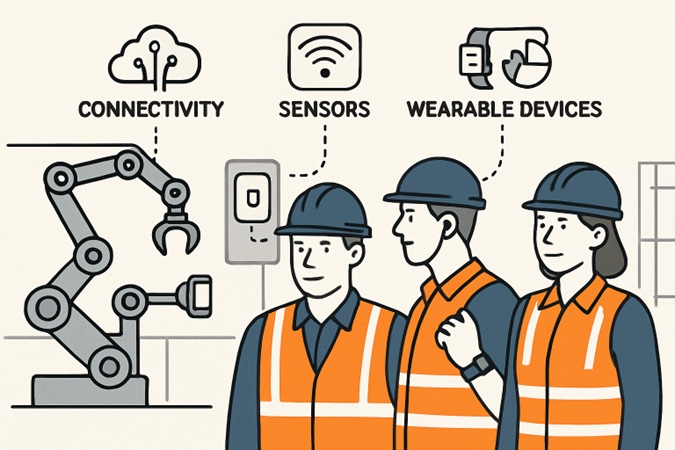
Artificial Intelligence (AI) and the Internet of Things (IoT) are becoming foundational technologies for industrial safety. These platforms allow safety teams to collect, process, and analyze data from a range of sensors and operational systems in real time. The Human-Agent Risk Navigation and Event Safety System (HARNESS), for example, merges large language models and structured work data. With this type of integration, hazardous trends or incidents can be anticipated, enabling teams to intervene early and effectively.
The adoption of AI and IoT extends beyond basic monitoring, enabling detailed predictive analytics. By capturing environmental metrics like temperature, air quality, and machinery status, organizations can identify unsafe trends before they escalate. Large manufacturers and logistics providers are adopting similar strategies to drastically reduce lost-time incidents and near misses, thereby improving worker safety and operational reliability. For additional trends in industrial safety innovation, visit StartUs Insights.
Wearable Technology For Worker Health
Wearable technologies are at the forefront of personalized occupational health and safety. Equipment such as smart helmets, sensor-equipped vests, and biometric wristwear is enabling detailed monitoring of worker health while on the job. These devices track key vital signs, including heart rate, body temperature, and even stress levels. As soon as a hazardous health parameter is detected, wearables can automatically send alerts to supervisors, enabling rapid response and potentially preventing medical emergencies. Companies in sectors such as construction and energy have seen significant improvements in safety records since implementing these tools.
Beyond health monitoring, many wearables now include geolocation features that help site managers track workers’ movements in dangerous zones and restricted areas. This not only ensures compliance with safety protocols but also underpins contact tracing and incident investigation efforts in the aftermath of accidents or exposures.
Automation & Robotics In Hazardous Tasks
Automation and robotics technology are taking over many of the most hazardous jobs across industries, ranging from chemical manufacturing to mining. Deployment of robots in these environments keeps employees out of reach of dangerous substances, extreme heat, or precarious machinery. Additionally, collaborative robots, or CoBots, are engineered to work alongside humans, handling repetitive or physically demanding tasks and reducing the risk of worker injury from overexertion.
Robotics are not just about replacing humans in dangerous tasks, but also about enhancing precision, consistency, and safety. For instance, robotics use in warehouse logistics or heavy manufacturing often leads to lower rates of musculoskeletal disorders and improved workplace morale. For further developments in this area, see this overview of robotics in the workplace from BBC News.
Virtual Reality For Safety Training
Virtual Reality (VR) platforms have changed the way organizations approach workplace safety training. Through fully simulated scenarios, employees can practice hands-on safety procedures without risking actual harm. VR modules support immersive, experiential learning in fields such as mining, logistics, aviation, and emergency response. This has led to measurable gains in knowledge retention and compliance, bolstering long-term safety outcomes.
Customized VR simulations can be tailored to individual facility layouts and equipment for maximum relevance. With global operations embracing this method as a core training component, VR is helping bridge the gap between theoretical instruction and practical execution, increasing confidence and preparedness across diverse teams.
Data Analytics For Hazard Prevention
The influx of digital information from modern industrial processes provides a foundation for advanced data analytics. Companies now leverage real-time and historical data to pinpoint emerging hazards, optimize workflows, and track compliance indicators. Artificial intelligence-driven analytic platforms play a key role in identifying unsafe patterns or potential system failures long before an incident occurs, enabling the implementation of preemptive solutions. Learn how AI is transforming workplace safety.
Real-world use cases highlight substantial reductions in recurring safety incidents and improved regulatory compliance due to predictive modeling. For insight into how analytics is evolving labor safety globally, visit Occupational Health & Safety Magazine.
Conclusion
Innovative safety solutions are reshaping what is possible in industrial workplaces. By adopting AI, IoT, wearable technology, automation, VR training, and robust data analytics, organizations can not only standardize best practices but also create a genuinely safer and more productive environment. Staying ahead by integrating these progressive tools ensures compliance, improves efficiency, and, importantly, safeguards the well-being of every team member.