
Table of Contents
Navigating The Complexity Of Modern Fluid Systems
The intricate networks of tubes and pipes that transport vital fluids and gases are the lifeblood of industrial operations. From chemical processing plants to oil and gas refineries to semiconductor manufacturing, these systems operate under demanding conditions. The reliability of these fluid systems, especially small-bore configurations, hinges on the quality and integrity of every single connection point. A single leak can pose significant safety hazards, cause environmental damage, lead to costly downtime, and result in a drastic reduction in operational efficiency. Therefore, understanding the nuances of tube fittings is paramount for engineers and facility managers.
The Role Of Precision Components
At the heart of any robust fluid system lies a carefully selected array of components, with tube fittings playing a particularly critical role. These seemingly small parts are responsible for creating leak-tight seals that withstand the rigors of system pressure, temperature fluctuations, and mechanical stress. Our collective industry experience has shown that the careful selection and proper installation of these components are non-negotiable for maintaining system integrity and adhering to stringent safety protocols. Whether transferring corrosive chemicals, high-purity gases, or volatile liquids, the performance of each fitting directly impacts the overall safety and efficiency of fluid transfer and gas containment.
We recognize that the choice of fitting can significantly influence the longevity and reliability of an entire system. This is why we advocate for a meticulous approach to component selection, ensuring that each fitting is perfectly suited to its specific application. The foundation of a reliable system begins with high-quality components, and this principle guides our approach to industrial tube fittings.
Critical Properties Of Industrial Piping Materials
The material composition of tube fittings is a primary determinant of their suitability for harsh industrial environments. Different alloys offer varying degrees of resistance to corrosion, extreme temperatures, and mechanical stress. Understanding these properties is crucial for making informed decisions that ensure system longevity and safety. To gain a deeper understanding of how these components are applied, we often refer to resources that detail Understanding tube fitting applications.
Material Max. Temperature ( 0F / 0C) Typical Pressure Rating (PSI) Key Characteristics 316 Stainless Steel 1000 0F (537 0C) Varies, often high Excellent corrosion resistance, good strength Carbon Steel 375 0F (190 0C) Varies, often high Cost-effective, good strength, requires corrosion protection 6-Moly 600 0F (315 0C) Very high Superior corrosion resistance, especially in chlorides Alloy 625 1000 0F (537 0C) Very high High strength, corrosion and oxidation resistant Alloy 825 800 0F (426 0C) Very high Excellent resistance to acids and stress-corrosion cracking Alloy 2507 482 0F (250 0C) Very high Super duplex, high strength and corrosion resistance Note: Pressure ratings are highly dependent on fitting type, size, and specific design, and are typically based on ambient temperature. Consult manufacturer specifications for precise data.
Corrosion Resistance In Industrial Piping Materials
Corrosion is a pervasive threat in industrial settings, capable of compromising the integrity of piping systems and leading to catastrophic failures. The choice of material for tube fittings must therefore directly address the corrosive nature of the fluid being transported and the surrounding environment. For instance, 316 stainless steel is widely favored for its excellent corrosion resistance due to its chromium and molybdenum content, allowing it to withstand temperatures up to 1000 °C.0F (537 0C). This makes it a robust choice for applications where oxidation and general corrosion are concerns.
In contrast, carbon steel pipe fittings, while offering good mechanical strength, are inherently susceptible to corrosion. To mitigate this, they are often treated with electrodeposited zinc plating to resist corrosion, thereby extending their lifespan in moderately corrosive environments. However, for highly aggressive media or environments, more advanced materials are necessary. Nickel alloys such as Alloy 625 and Alloy 825, or duplex stainless steels such as Alloy 2507, provide superior resistance to pitting, crevice corrosion, and stress-corrosion cracking, making them indispensable in the harshest chemical processing and offshore applications. When applications demand the highest levels of cleanliness and corrosion resistance, such as in food, beverage, or pharmaceutical industries, understanding sanitary fitting requirements becomes critical.
Temperature Limits For Industrial Piping Materials
Temperature extremes, both high and low, pose significant challenges to the structural integrity and sealing capabilities of tube fittings. Materials must be selected to maintain their mechanical properties and dimensional stability across the entire operating temperature range. As noted, 316 stainless steel pipe fittings can withstand temperatures up to 1000 0F (537 0C), making them suitable for many high-temperature processes. However, in cryogenic applications, specific grades of stainless steel or specialized alloys are required to prevent embrittlement.
Carbon steel, while robust at ambient temperatures, has a more limited temperature range, typically treated for use up to 375 0F (190 0C) due to its zinc plating. Exceeding this limit can compromise the integrity of the plating and the fitting’s corrosion resistance. Thermal shock, caused by rapid temperature changes, can also induce stress and fatigue in materials, necessitating careful selection of alloys with appropriate thermal expansion coefficients and fatigue resistance. The inherent strength and resilience required to withstand these thermal stresses are also key considerations in the design of components such as butt weld fitting durability, which are designed for permanent, high-integrity connections.
Mechanical Design & Selection Of Tube Fittings
The mechanical design of a tube fitting is as critical as its material composition. It dictates how the fitting interacts with the tubing to create a seal, resist external forces, and allow for maintenance. We generally categorize tube fittings into several primary types, each with distinct advantages and ideal applications:
- Threaded Fittings: Rely on mating threads to create a connection, often requiring sealant for a leak-tight seal.
- Compression Fittings: Utilize one or more ferrules compressed onto the tube to form a seal and grip.
- Mechanical Grip Fittings: An advanced form of compression fitting, designed for enhanced vibration resistance and robust sealing.
- Cone and Thread Fittings: Engineered for extremely high-pressure applications, requiring specialized tube preparation.
 Threaded Standards & Sealing Mechanisms
Threaded fittings are ubiquitous in industrial piping, forming connections by engaging male and female threads. The effectiveness and pressure rating of these connections depend primarily on the thread type and the sealing mechanism used.
Two of the most common international standards for threaded fittings are National Pipe Thread (NPT) and British Standard Pipe (BSP). NPT threads, per ASME B1.20.1 and SAE AS71051, are tapered. This taper allows the male and female threads to wedge together, creating a mechanical seal as they are tightened. For optimal leak-tightness, particularly in higher-pressure applications, a thread sealant or PTFE tape is typically applied to fill the helical leak path. Tapered threads are effective for system pressures up to 15,000 psi, demonstrating their robustness in demanding scenarios.
In contrast, straight threads (often found in BSP parallel threads) do not create a seal through thread engagement alone. Instead, they rely on a gasket or an O-ring compressed between the fitting faces to achieve a leak-tight connection. Threaded fittings with straight threads are typically used in applications where system pressure will not exceed 5,000 psi, making them suitable for lower-pressure systems that require easy assembly and disassembly. The choice between tapered and straight threads often comes down to specific application requirements, pressure ratings, and user preference, but understanding the sealing mechanism is crucial for proper installation and preventing leaks. For applications requiring flexible connections or transitions between different pipe sizes, pipe adapters and bushings offer versatile solutions.
The Evolution Of Compression & Mechanical Grip
Compression fittings represent a significant advancement in tube connection technology, offering a reliable, re-removable, and often simpler alternative to welding or threading. Their core principle involves compressing a ferrule (or ferrules) onto the outside diameter of the tubing, creating both a mechanical grip and a fluid-tight seal.
Early designs often featured a single-ferrule. While effective for many applications, single-ferrule fittings can be susceptible to vibration and thermal cycling, leading to loosening or leakage over time.
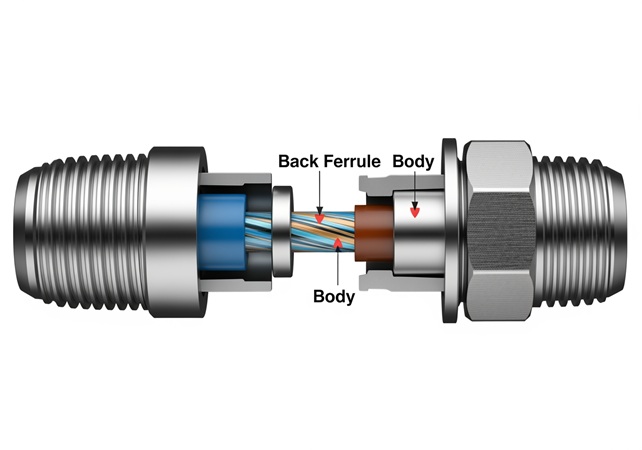
The innovation of the double-ferrule (or two-ferrule) design significantly enhanced the performance of compression fittings. In a two-ferrule system, the front ferrule creates the primary seal on the tube, while the back ferrule provides a robust mechanical grip and absorbs vibration. This design distributes the gripping and sealing functions, resulting in a more secure, leak-tight connection. The hinging-collecting action of the back ferrule, for instance, can create an even more robust grip and seal by ensuring more material of the back ferrule is in close contact with the tube adjacent to the tube grip. This design provides high vibration resistance while maintaining appropriate grip and force, a critical factor for dynamic systems.
Mechanical grip fittings are an evolution of these two-ferrule compression designs, particularly engineered for medium-pressure applications and environments prone to vibration. These fittings often incorporate a dynamic wedge or similar mechanism that ensures a consistent, removable pull-up and gaugeability, allowing for verification of proper installation. The robust design of these fittings, including the ‘spring back’ phenomenon that maintains ferrule compression, contributes to their exceptional reliability in systems that experience pulsation, thermal shock, or side loading. For a comprehensive overview of the various types available, exploring James Duva industrial tube fittings can provide valuable insights.
Engineering For Extreme Pressure & Vibration
Industrial fluid systems frequently operate under conditions that challenge the limits of conventional fittings. High system pressure, constant vibration, and dynamic stresses such as pulsation and side loading require specialized engineering solutions to maintain leak-tight integrity. The ability of a fitting to resist vibration while maintaining its seal and grip is a hallmark of robust design. Two-ferrule, mechanical grip fittings, for example, are specifically designed to provide high vibration resistance while maintaining appropriate grip and force, ensuring reliability in demanding applications.
High-Pressure Cone & Thread Requirements
When pressures exceed the capabilities of standard compression or threaded fittings, cone-and-thread fittings are the preferred solution. These fittings are specifically designed for medium- to high-pressure applications, often handling pressures of 15,000 psi or higher. Their robust design makes them a standard choice in demanding sectors such as oil and gas, research, and high-pressure hydraulics.
The distinctiveness of cone-and-thread fittings lies in their specialized preparation and assembly. They require thick-walled tubing that must be precisely coned and threaded with specialized tools. The assembly involves a gland, a collar, and a female port. The coned end of the tubing seats into the female port, creating a metal-to-metal seal, while the collar and gland provide the mechanical force to hold the connection together. Many high-performance cone-and-thread fittings also incorporate a weep hole, a safety feature that allows visual detection of a primary seal leak before a full system failure. Proper installation, including lubrication and careful handling to prevent burrs or scratches, is essential for reliable, long-term performance in strenuous fluid-system environments. In applications with regular shock or vibration, anti-vibration components may be necessary to augment the fitting’s inherent strength.
Managing Alignment With Tube Adapters
In complex piping layouts, achieving perfect alignment between components can be a significant challenge. Misalignment can introduce stress into the system, compromise seals, and complicate installation, potentially leading to premature failure. This is where tube adapters play a crucial role.
Tube adapters are versatile components designed to facilitate various connections and effectively address alignment issues. They can bridge different connection types, allowing seamless transitions, for example, between a tube fitting and a threaded port, or between different tube sizes (e.g., fractional to metric conversion). By providing flexibility in connection points, adapters reduce the need for precise tube bending or complex manifold designs, minimizing installation fatigue and improving overall system integrity. They can also simplify maintenance by allowing specific sections of a system to be easily disconnected and reconnected. The strategic use of adapters can significantly enhance the modularity and maintainability of a fluid system. Given the vast array of options, a comprehensive guide to selecting the right fittings can be an invaluable resource.
Best Practices For Leak-Tight Installation
Achieving leak-tight performance and operational efficiency in any fluid system is not solely dependent on selecting high-quality components; it equally relies on meticulous preparation and correct installation. Even the most advanced tube fitting can fail if improperly installed.
One critical aspect is ensuring proper torque-on-assembly for compression fittings. Over-tightening can damage ferrules or tubing, while under-tightening can lead to leaks. Many manufacturers provide specific pull-up procedures and recommend using a gap inspection gauge to verify that the fitting has been sufficiently tightened. This gauge provides a visual confirmation that the ferrules have been properly set, ensuring a reliable seal.
For threaded fittings, preventing galling (cold welding of threads) and ensuring a seal requires careful attention. The use of appropriate thread sealants or PTFE tape is crucial for tapered threads, filling minute imperfections, and preventing leaks. For straight threads, confirming the presence and correct seating of gaskets or O-rings is paramount. Proper tube preparation, including clean, burr-free cuts and appropriate deburring, is also essential for all fitting types to ensure optimal ferrule seating and seal integrity.
Reassembly & Maintenance Protocols
The ability to reassemble fittings without compromising performance is a significant advantage in industrial settings, facilitating maintenance, inspection, and system modifications. Compression and mechanical grip fittings are often designed for multiple reassemblies, provided the original installation was correct, and the components are not damaged.
During reassembly, it is vital to inspect all components for wear, deformation, or corrosion. Ferrules, in particular, should be checked for cracks or excessive scoring. Following manufacturer-specific reassembly procedures, which often involve a fractional turn past finger-tight, is critical to re-establish the seal. The use of inspection gauges can again be beneficial to confirm proper re-tightening. Maintaining accurate records of component traceability, including material heat codes, can also aid in troubleshooting and ensuring long-term reliability. For other types of connections, such as welded systems, understanding standard weld fitting dimensions is key to ensuring proper fit and structural integrity.
The Risks Of Component Intermixing
A common pitfall in industrial fluid system management is the intermixing or interchanging of tube fitting components from different manufacturers. While some fittings may appear visually similar, their internal geometries, material compositions, and manufacturing tolerances can vary significantly. These subtle differences can have profound implications for system performance and safety.
Intermixing components can lead to:
- Incompatible Sealing Surfaces: Variations in ferrule angles or body seat geometry can prevent a proper seal, leading to leaks.
- Mismatched Material Properties: Different manufacturers may use slightly different alloys or heat treatments, which can affect the ferrules’ ability to grip the tubing or resist corrosion.
- Differing Mechanical Tolerances: Even slight dimensional deviations can result in improper compression, leading to under-tightening, overstressing, or inadequate tube grip.
- Compromised Vibration Resistance: The engineered interaction between specific ferrules and fitting bodies, designed to resist vibration, can be lost when components are mixed.
- Voided Warranties and Safety Hazards: Most manufacturers explicitly state that intermixing components voids product warranties and, more importantly, can create unpredictable and unsafe operating conditions. The potential for catastrophic failure due to compromised connections far outweighs any perceived short-term cost savings.
For these reasons, we strongly advise against intermixing components. For optimal performance, reliability, and safety, it is always best practice to use a complete tube fitting assembly from a single manufacturer.
Frequently Asked Questions About Industrial Piping
What is the primary advantage of a two-ferrule fitting over a single-ferrule design?
The primary advantage of a two-ferrule fitting lies in its superior performance, particularly in terms of vibration resistance and sealing integrity. In a two-ferrule design, the functions of sealing and gripping the tube are separated between the front and back ferrules. The front ferrule creates a leak-tight seal against the fitting body and the tube, while the back ferrule provides a robust mechanical grip on the tube and absorbs vibrational stresses. This independent action results in a more secure connection, enhanced resistance to vibration, and better support for the tube, leading to greater reliability and reduced leakage compared to single-ferrule designs, where a single ferrule performs both tasks.
When should cone-and-thread fittings be used instead of compression fittings?
Cone and thread fittings should be used in applications demanding extremely high pressures, typically exceeding 15,000 psi, or in severe service environments where the robust, metal-to-metal seal and mechanical security are paramount. While compression fittings are excellent for many industrial applications, cone-and-thread fittings are specifically engineered for the highest pressure ranges. They require specialized thick-walled tubing and precise preparation (coning and threading) to create a highly secure, non-re-makeable connection that can withstand immense forces and provide exceptional leak integrity under extreme conditions.
How does material selection impact the longevity of a tube fitting?
Material selection profoundly impacts the longevity of a tube fitting by determining its resistance to the specific operating conditions. For instance, in corrosive environments, using 316 stainless steel or nickel alloys (like 6-Moly or Alloy 625) significantly extends fitting life by resisting chemical attack, pitting, and crevice corrosion, compared to carbon steel, which would quickly degrade. Similarly, for high-temperature applications, materials like 316 SS or Alloy 625 maintain their mechanical strength and integrity, whereas carbon steel would soften and fail. Conversely, in cryogenic service, materials must resist embrittlement. Proper material selection ensures the fitting can withstand the chemical, thermal, and mechanical stresses of its environment, directly contributing to system reliability and reducing the frequency of maintenance and replacement.
Conclusion
Navigating the complexities of modern industrial fluid systems demands a comprehensive understanding of tube fittings, encompassing materials science, mechanical design, and installation best practices. We have explored how the right choice of alloy provides critical resistance to corrosion and extreme temperatures, forming the foundation of a durable system. We’ve also delved into the distinct characteristics of threaded, compression, mechanical grip, and cone-and-thread fittings, highlighting their unique advantages for addressing various pressure and vibration challenges.
Achieving leak-free operation and long-term reliability requires meticulous component selection, adherence to installation protocols, and a commitment to integrated systems from a single manufacturer. The consequences of intermixing components or failing to install them properly can be severe, including safety hazards, operational inefficiencies, and costly downtime. By prioritizing high-quality components and continuous professional training, industries can build fluid systems that not only meet stringent performance dstandardsbut also ensure tersonnel and tenvironmental safety