
Table of Contents
The Rise Of The All-In-One Vessel: What Defines A Crossover Boat?
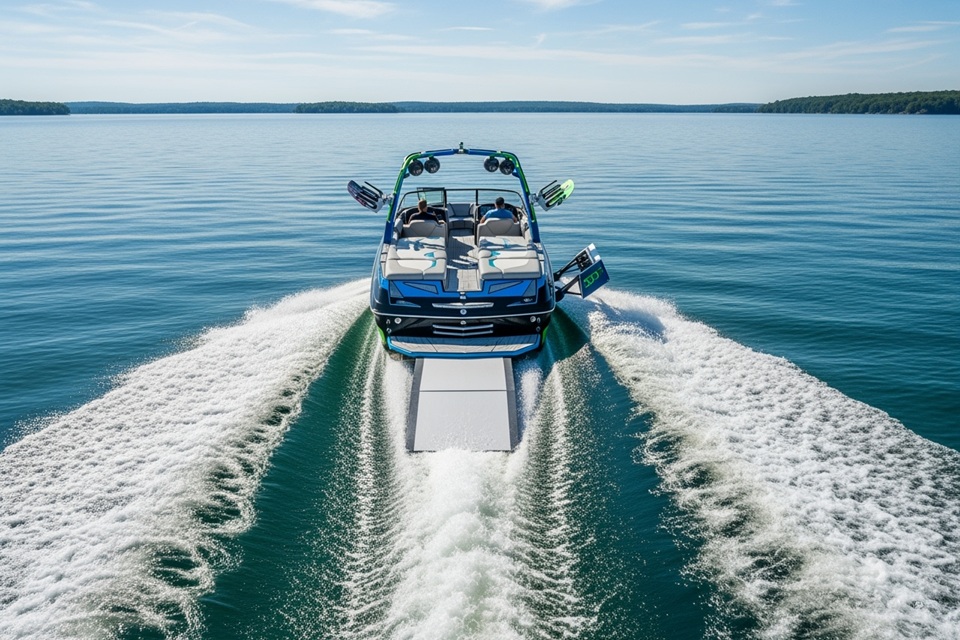
At their core, crossover boats are the ultimate “cruising chameleons” of the marine world. They are carefully designed to seamlessly transition between a diverse array of on-water activities, from high-octane watersports to tranquil family cruises and even serious fishing expeditions. This multi-faceted capability is precisely what defines them and sets them apart from more specialized vessels.
A significant influence on the modern crossover boat is the ubiquitous bowrider. Known for their open bow seating and spacious cockpits, bowriders laid the groundwork for the social and comfort-oriented layouts seen in today’s crossovers. However, crossovers lift this concept by integrating sophisticated watersports capabilities. Often, this is achieved through a V-drive configuration, where the engine is mounted further aft. This design not only optimizes weight distribution for wake creation but also opens up the mid-ship area, creating more usable space for passengers, storage, and amenities – a key feature for family-centric design.
The market trends clearly indicate a growing preference for vessels that combine sport and leisure without compromise. Boaters are increasingly seeking a single solution that caters to everyone’s interests, eliminating the need for multiple boats or settling for a vessel that only excels in one area. This demand has fueled the rapid evolution of the crossover segment, making these versatile boats a dominant force in recreational boating.
From Niche To Mainstream
For decades, the boating industry was largely segmented by specialized vessels. If you were a serious slalom skier, you bought a direct-drive ski boat, characterized by its flat wake. If wakeboarding was your passion, you sought out a dedicated wake boat with its deep-V hull and massive ballast systems. These specialized boats excelled in their specific niches, but they offered limited versatility for other activities.
However, boater needs have evolved. Families and groups of friends often have diverse interests, and the idea of owning multiple boats, each dedicated to a single sport, is often impractical and cost-prohibitive. This shift, coupled with the decline in direct-drive ski boat production, created a significant demand for a more versatile solution. Crossover boats emerged as the answer, bridging the gap by incorporating technological advancements that allow a single hull to adapt to various wake requirements. This increased demand for versatility has propelled crossovers from a niche concept to a mainstream staple in the boating world.
The Two Main Types Of Crossover Boats
While the term “crossover” broadly refers to versatility, two main types dominate the market, each with distinct priorities:
- Watersports-Focused Crossovers: These are the “tri-athletes” of the boating world, primarily designed for skiing, wakeboarding, and wakesurfing. Manufacturers like Malibu, Nautique, Tigé, MasterCraft, and Supra lead this segment. Their designs prioritize advanced wake-shaping technologies, powerful inboard engines, and comfortable, spacious cockpits with ample seating and storage for watersports gear. The Malibu Wakesetter 20 VTX, for example, is renowned for its ability to produce a wake that wakeboards, skis, and surfs exceptionally well, truly earning its title as “The Crossover King.” These boats often feature sophisticated touchscreen control systems to fine-tune wake characteristics on the fly.
- Fish-and-Ski (or Multi-Sport) Models: This category blends the utility of a fishing boat with the recreational capabilities of a watersports vessel. Brands like Lund, with their 1875 Crossover XS, exemplify this type. These boats feature elements like livewells, casting platforms, and rod storage, alongside ski pylons, comfortable seating, and often powerful outboard engines. The 1875 Crossover XS, for instance, is described as the “ideal combination of an 18-foot fish and ski boat,” capable of handling fishing, tubing, wakeboarding, and water skiing. While they may not offer the extreme wake performance of dedicated watersports crossovers, they provide a fantastic balance for families who enjoy both angling and towed activities.
Beyond these two primary types, there’s also a niche of “hunt-and-fish utility” crossovers, as highlighted in some sources. These vessels prioritize ruggedness and concealment for hunting, while still offering fishing capabilities. The hull design differences are crucial here; watersports crossovers typically feature deeper V-hulls for wake creation, while fish-and-ski models might use modified-V hulls for better performance in varied conditions and shallower drafts. Feature variations, such as specialized rod lockers versus wakeboard storage, further distinguish these types.
Key Features That Power Versatility In Crossover Boats
The magic of crossover boats lies in their adaptable technology and smart design, engineering solutions that allow a single vessel to excel across multiple disciplines. This isn’t just about throwing a ski pylon on a fishing boat; it’s about integrated systems and intelligent layouts that provide genuine onboard comfort and performance for diverse activities.
Hull Design: The Foundation Of Adaptability
The hull is the heart of any boat, and in crossovers, its design is paramount to achieving versatility.
- V-hull: Most crossover boats use some form of a V-hull, which provides a smoother ride in choppy water and contributes to wake formation.
- Diamond Hull concept: Malibu’s Wakesetter 20 VTX, for example, features a “Diamond Hull,” specifically engineered to produce clean, firm wakes for wakeboarding and surfing, while also capable of flattening out for slalom skiing at tournament speeds.
- Convex hull theory: Tigé boats employ a patented “Convex hull” design, which allows the boat to ride deeper in the water at slower speeds, naturally creating larger wakes and waves without needing as much ballast. As speed increases, the hull lifts, reducing drag and flattening the wake for skiing.
- Modified-V for fishing: For fish-and-ski models, a modified-V hull might be preferred, offering a balance of stability for fishing and decent performance for watersports, often with a shallower draft for accessing different fishing spots. The careful sculpting of the hull directly influences wake creation, allowing the boat to generate everything from a near-flat slalom wake to a sizable ramp for wakeboarding, or a long, clean wave for wakesurfing. Simultaneously, these designs aim to provide a smooth ride for general cruising and passenger comfort.
Advanced Wake & Wave Shaping Technology
This is where modern crossover boats truly shine, leveraging sophisticated systems to customize the wake for any activity:
- Integrated Ballast Systems: These systems fill internal tanks with water to add weight, sinking the boat deeper and increasing wake size. Capacities vary significantly by model, with the Malibu 20 VTX capable of being optioned with up to 3,575 pounds of ballast, the Nautique Super Air GS20 offering 1,850 pounds, the Tigé 20RZX boasting 3,000 pounds, and the MasterCraft XT21 integrating 2,640 pounds. The ability to quickly fill and drain these tanks, often at the push of a button, is crucial for rapid transitions between sports.
- Hydrofoils and Wedges: Malibu’s Power Wedge III is a prime example. This hydrofoil deploys from the transom, adding the equivalent of 1,500 pounds of ballast by forcing the stern down, effectively shaping the wake without adding physical weight.
- Surf Tabs and Gates: These are game-changers for wakesurfing. Malibu’s Surf Gate, Nautique’s NCRS (Nautique Configurable Running Surface), Tigé’s TAPS 3, MasterCraft’s Gen2 Surf System, and Supra’s AutoWake and Swell 3.0 Surf system all use various forms of adjustable plates or gates on the transom to redirect water flow. This creates a clean, surfable wave on one side of the boat, allowing riders to switch sides easily and even transfer from one side to the other while riding.
- Touchscreen Controls: The complexity of these systems is managed through intuitive touchscreen interfaces, such as Malibu’s Command Center, Nautique’s Linc Panoray, or MasterCraft’s Clear touchscreen. These digital dashboards allow drivers to precisely control ballast, speed, wake shape, and even save personalized “rider profiles” for instant recall, removing the guesswork from wake control.
- Automated Systems: Many systems now feature automated functions, like Supra’s AutoWake, which constantly monitors and adjusts ballast to maintain a consistent wake or wave, even as passengers move around the boat.
Smart Layouts & Onboard Amenities
 Beyond performance, crossover boats are designed for maximum comfort and utility, ensuring an enjoyable experience for everyone on board:
- Wraparound Lounges and Convertible Seating: These flexible seating arrangements maximize passenger capacity and comfort. Many models feature U-shaped or L-shaped lounges that can convert into sun pads or additional seating. Formula SSCs and ASCs, for example, offer double and triple helm seating and wrap-around lounges, emphasizing social interaction.
- Ample Storage: Crossovers offer clever storage solutions for all types of gear. This includes large in-floor storage compartments for wakeboards and skis, dedicated ski pylons for easy towing, and often integrated rod lockers for fishing gear, as seen in the Lund 1875 Crossover XS which boasts a lockable center rod locker for up to 10 rods and lower center wakeboard storage.
- Wakeboard Towers and Ski Pylons: Most watersports crossovers come equipped with sturdy towers for wakeboarding and wakesurfing, providing a higher tow point for aerial maneuvers. Many also include pop-up ski pylons for traditional water skiing and tubing, offering a lower, more controlled tow point.
- Premium Audio Systems: High-quality marine audio systems, often with multiple speakers, subwoofers, and tower speakers, are standard, enhancing the entertainment experience on the water.
- Convenience Features: Modern amenities like wet bars, integrated coolers, USB charging ports, wireless phone chargers, and even enclosed heads (bathrooms) are common, changing the boat into a comfortable floating lounge.
- Seating Capacity: Crossover boats are built to accommodate groups. The Malibu Wakesetter 20 VTX seats up to 11 people, the Nautique Super Air GS20 seats 12, the Tigé 20RZX seats 13, the MasterCraft XT21 seats 14, and the Supra SR seats 14. Even the more compact Lund 1875 Crossover XS has a maximum capacity of 8 people, making them ideal for family and friends.
The Crossover Advantage: Why Boaters Are Choosing Versatility
The appeal of crossover boats is multifaceted, extending far beyond their technical capabilities. For many boaters, they represent a smarter, more enjoyable approach to life on the water.
One of the most compelling advantages is cost-effectiveness. Instead of investing in a dedicated ski boat, a separate fishing boat, and perhaps a comfortable cruiser, a single crossover boat can fulfill all these roles. This not only reduces the initial purchase price but also lowers ongoing expenses related to maintenance, insurance, and storage for multiple vessels. It’s the ultimate “one-boat solution” for families with diverse interests.
This singular focus simplifies ownership considerably. Instead of juggling different maintenance schedules or finding specialized storage for various boats, everything is consolidated into one manageable package. This convenience translates directly into more time spent on the water and less time dealing with logistical headaches.
Crossover boats excel at social boating because they genuinely cater to everyone. Dad can enjoy a morning fishing, the kids can spend the afternoon wakeboarding, and Mom can relax with friends while cruising the lake, all on the same vessel. This inherent ability to accommodate varied interests fosters more family fun and ensures no one feels left out. The flexibility to switch activities on the fly means that spontaneous decisions are easily accommodated, maximizing enjoyment for all.
Furthermore, the practical benefits of a single, versatile boat are significant. Many crossover models are designed to be easily trailerable, making transportation to different lakes or bodies of water a breeze. The Malibu Wakesetter 20 VTX, for example, weighs only 3,950 pounds, making it easily trailerable, and the Lund 1875 Crossover XS weighs a mere 1669 lbs. This ease of transport also contributes to storage benefits, as a single boat typically requires less space than multiple specialized vessels.
For those looking to find the perfect blend of features and value, exploring the wide variety of crossover boats for sale can reveal options for every budget and lifestyle. The market is rich with diverse models, ensuring that whether you prioritize watersports performance, fishing utility, or luxurious comfort, there’s a crossover boat designed to meet your specific needs.
Understanding The Trade-Offs & Making The Right Choice
 While crossover boats offer unparalleled versatility, it’s crucial to approach a purchase with informed decisions. Like any multi-purpose tool, there are inherent trade-offs. No single boat can be absolutely perfect at everything, and understanding these compromises is key to balancing your needs and setting your priorities. The goal isn’t to find a mythical “perfect boat,” but rather the best fit for your specific lifestyle and boating aspirations.
Performance For The Purist: Where Crossovers Compromise
For the expert-level watersports enthusiast, a crossover boat might present certain limitations compared to a hyper-specialized vessel:
- Slalom Wake Comparison: Hardcore slalom skiers, particularly those who compete or train in courses, often seek a perfectly flat, soft wake. While modern crossovers like the Malibu 20 VTX with its Diamond Hull can flatten their wake significantly, they may not achieve the absolute minimal, softest wake of a dedicated, direct-drive tournament ski boat like the Malibu Response TXi (a 13-time world record holding, tournament-approved three-event boat). The Response TXi, designed purely for skiing, offers a level of wake refinement that is difficult for a multi-purpose boat to replicate.
- Competition-Level Waves: Similarly, competitive wakeboarders and wakesurfers might find that while crossovers produce excellent, surfable waves, they may not match the sheer size, steepness, or perfect lip of waves generated by dedicated, pro-level wake boats. These specialized vessels are engineered with massive ballast capacities and intricate hull designs solely for creating the largest, most sculpted wakes possible.
- Specialized Boat Benefits: Dedicated boats often offer nuances in handling, tracking, and power delivery that are optimized for their single purpose. For instance, the precise tracking of a direct-drive ski boat in a slalom course is best. The reality is that a crossover boat is a “jack-of-all-trades,” performing very well across many disciplines, but not necessarily mastering any one to the extreme, particularly for elite-level performance. For the vast majority of recreational boaters, this slight compromise is far outweighed by the immense versatility and convenience.
Key Considerations Before You Buy A Crossover Boat
To make the right choice, consider these factors:
- Primary Use: What activities will you engage in most frequently? If you’re 80% fishing and 20% watersports, a fish-and-ski model might be ideal. If it’s the reverse, a watersports-focused crossover would be better.
- Budget and Price Ranges: Crossover boats come in a wide range of prices. Entry-level fish-and-ski models like the Lund 1875 Crossover XS start around $54,795. High-end watersports crossovers can range from around $99,495 for a MasterCraft XT21, $101,829 for a Tigé 20RZX, $105,690 for a Malibu 20 VTX, $110,024 for a Nautique Super Air GS20, and up to $120,200 for a Supra SR. Consider not just the sticker price but also financing options and long-term ownership costs.
- New vs. Used: Buying used can offer significant savings, but requires careful inspection and understanding of maintenance history. New boats come with warranties and the latest technology.
- Seating Capacity: How many people will typically be on board? Ensure the boat’s maximum capacity comfortably accommodates your family and friends. Crossover boats typically hold between 6 and up to 12 passengers, with some models like the MasterCraft XT21 and Supra SR accommodating up to 14.
- Engine Power: Ensure the engine has sufficient horsepower for your intended activities, especially if you plan on towing multiple wakeboarders or surfers. The Lund 1875 Crossover XS, for example, has a maximum HP capacity of 175 HP.
- Customization Options: Many manufacturers offer extensive customization programs, allowing you to personalize colors, upholstery, and features. Formula’s FormulaFlex™ program, for instance, allows for deep personalization, from graphics to cabin fabrics, enabling buyers to truly make the boat their own.
Frequently Asked Questions About Crossover Boats
Can a single boat truly excel at skiing, wakeboarding, and surfing?
A crossover boat is designed to perform well across all three disciplines, offering more than adequate results for most enthusiasts. While a professional competitor might prefer a hyper-specialized boat for a single sport, a crossover provides unparalleled versatility for families and groups with diverse interests, allowing everyone to participate and have fun. Modern crossovers achieve this through adaptable hull designs (like Malibu’s Diamond Hull or Tigé’s Convex hull), advanced ballast systems, and sophisticated wake-shaping technologies (such as Malibu’s Surf Gate and Power Wedge, Nautique’s NCRS, or MasterCraft’s Gen2 Surf System). These systems allow the driver to quickly adjust the wake or wave profile to suit the activity, making seamless transitions possible. For instance, the Malibu Wakesetter 20 VTX has a hull that wakeboards as well as it skis and surfs, making it a true master of versatility.
What size crossover boat is best for a family?
The 20- to 23-foot range is often considered the sweet spot for crossover boats. These boats are large enough to provide ample seating for 10-14 people and create impressive wakes, yet they remain relatively easy to trailer, maneuver, and store in a standard garage. For example, the Malibu 20 VTX is 20 feet long and seats 11, while the MasterCraft XT21 is 21 feet, 4 inches and seats 14. This size offers a good balance of space, performance, and practicality. The best size ultimately depends on your family’s size, typical lake conditions (larger boats handle choppy water better), and storage capabilities (some 20-foot models can fit in a standard garage with the tower folded down).
Are crossover boats only for watersports?
Not at all. While many are optimized for towed sports, the “crossover” concept extends to other activities. Fish-and-ski models are extremely popular, combining features like livewells (e.g., the Lund 1875 Crossover XS has a 24-gallon rear livewell) and casting decks with ski pylons and comfortable seating. These boats are perfect for families who enjoy both fishing and watersports. There are also hunt-and-fish crossovers designed for utility in various conditions, proving the platform’s adaptability. The core idea of a crossover is versatility, meaning the boat can adapt to a wide range of on-water activities beyond just skiing, wakeboarding, and surfing.
Conclusion
Crossover boats are undeniably making waves in the watersports world, redefining what a single vessel can achieve. They represent the ultimate family boat, masterfully blending high-performance capabilities for watersports with the comfort and amenities of a recreational cruiser. This innovative approach allows families and groups to maximize their time on the water, catering to diverse interests without the need for multiple specialized boats.
As the boating community continues to seek efficiency, convenience, and multi-faceted enjoyment, crossover boats are ready to lead the future of recreational boating. Their ability to adapt, perform, and provide comfort across a spectrum of activities makes them an increasingly attractive choice. By understanding their defining characteristics, advanced features, and the inherent trade-offs, you can make an informed choice that truly maximizes your time on the water, ensuring every outing is an trip for everyone on board.

