

When a person’s care plan lives in a folder on someone’s desk, with details scattered through various emails, important details can get missed. Support workers may not have the latest updates, coordinators may double-handle tasks, and participants may not get the right support at the right time.
That’s why more NDIS providers are moving away from paper-based planning and towards real-time digital systems like support coordination software or end-to-end NDIS software. These tools make it easier to share accurate, up-to-date information and help teams provide care that’s consistent, responsive, and truly centred on the person.
Let’s look at why providers across Australia are stepping away from paper and how real-time care planning is becoming the new normal in disability support.
Table of Contents
What’s The Problem With Paper?
Paper records are still used in parts of the sector, especially among smaller or legacy-based services. While some small teams make it work, here’s what usually happens:
- Plans are outdated within days of being printed
- Support workers can’t easily access or update plans on the go, and things get forgotten
- Errors and missed information go unnoticed
- Files get lost, duplicated, or incorrectly stored
- Audits become overwhelming
Paper-based systems are reactive, not proactive. They tend to create bottlenecks, especially when multiple staff are involved, new staff come on board, or when a participant’s needs change quickly. Providers relying heavily on paper often get bogged down and find it hard to stay ahead of compliance requirements, especially when delivering person-centred support in real time.
Real-Time Care Planning: What It Means
In simple terms, real-time care planning means all participants’ care plans, progress updates, risks, and goals are stored in a central, digital space, accessible instantly to approved staff and individuals.
Instead of having a static file locked in an office drawer, staff can check and update plans live, from the office, on the road, or working remotely. Real-time care planning means every stakeholder has access to the same, most current information.
That includes:
- Goals and objectives
- Daily notes and progress tracking
- Incident logs
- Shift and support records
- Family communications
- Risk assessments
When paired with support coordination software, this approach helps everyone stay aligned and responsive at all times, from coordinators to support workers and managers. It really is a game-changer.
Why NDIS Providers Are Moving To Real-Time Systems
There’s no one reason. But the biggest drivers often include:
1. Accuracy
Updates are logged instantly, reducing the risk of errors, forgotten information, and double handling.
2. Accountability
Every action is traceable. No need to decipher handwriting or chase down unsigned documents.
3. Efficiency
Time spent on admin drops significantly. With the right tools in place, providers can quickly and easily track shifts, goals, incidents, and invoices without juggling five platforms.
4. NDIS Compliance
The NDIS Quality and Safeguards Commission expects providers to maintain clear, accurate, and up-to-date records. With digital tools like NDIS software, audit prep becomes less stressful and more predictable.
But What About Providers Who Still Use Paper?
It’s not uncommon. Some providers, particularly those with limited admin teams still rely on manual record-keeping. For them, the paper-based approach feels familiar and “safe.” It’s what they’ve always done.
But that familiarity often comes at a cost:
- Delays in communication
- Difficulty tracking plan changes
- Increased risk during audits
- Lost or incomplete records
The move to digital tools is therefore not about keeping up with the latest trends and tech, but keeping up with growing demand, greater expectations from participants and families, and rising compliance standards.
The biggest concerns holding providers back often include:
- Worry about staff learning new systems
- Upfront costs
- Fears around data security
- Not knowing where to start
These are real barriers, but they’re also solvable. Many digital systems are now designed specifically for NDIS providers, with training and local support built in from day one.
Key Differences At A Glance
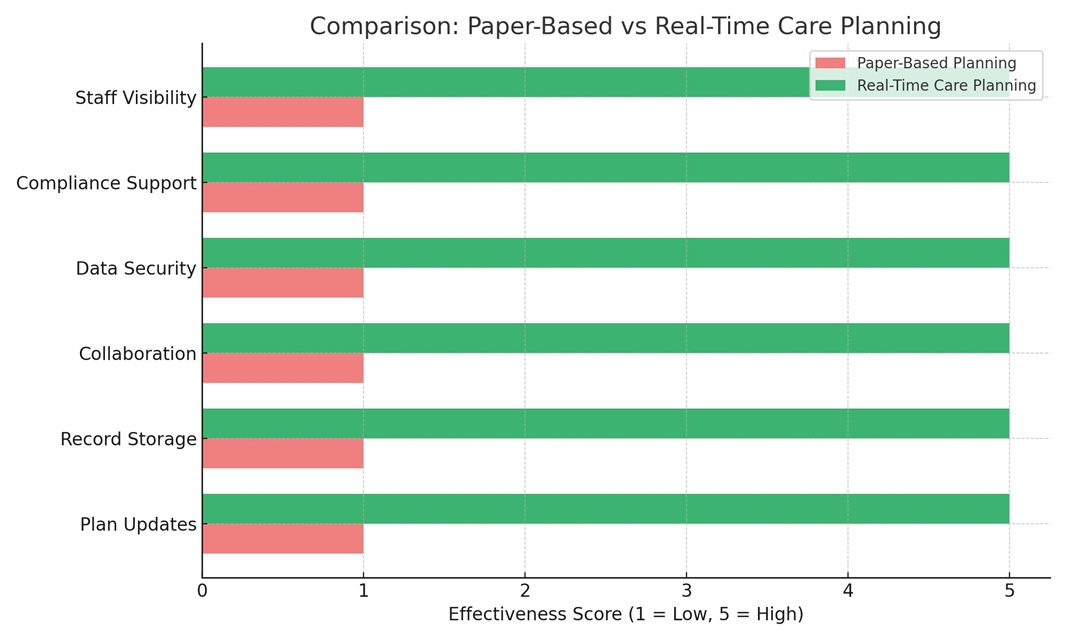
Here’s how paper-based and real-time systems compare in daily operations:
| Feature | Paper-Based Planning | Real-Time Care Planning |
| Plan Updates | Manual, often delayed | Live, accessible immediately |
| Record Storage | Physical folders | Secure cloud storage |
| Collaboration | Limited, slow | Multi-user access instantly |
| Data Security | Prone to loss/damage | Encrypted and backed-up |
| Compliance Support | Labour-intensive | Audit trails built-in |
| Staff Visibility | Fragmented | Shared dashboards and alerts |
 Coordinated Support Is Only As Strong As The System Behind It
When real-time planning becomes the norm, the role of support coordination software shifts from a “nice-to-have” to a core requirement. For coordinators managing numerous participants, each with unique needs, risks, goals, and timelines, having scattered documents or clunky tools slows everything down. In the end, the participant suffers.
In the past, updates might’ve taken days to flow between coordinators, workers, and family members. But with the right system in place, a note from a worker or an updated plan goal is visible instantly with no follow-ups and no crossed wires.
Here’s what makes the difference:
- Coordinators can view updated participant profiles on the spot
- Tasks and check-ins are easy to track without sticky notes or email threads
- Reviews and plan expiry dates are never forgotten because reminders are built in
- Notes, incidents, and communications are all kept together
When a support coordination software works well, it strengthens the link between planning and delivery. Participants aren’t just receiving support, they’re supported according to a live, transparent plan that reflects their current needs and preferences.
What Providers Can Do Next
If you’re still relying on paper, here’s how to start moving toward a real-time system without overhauling your entire setup overnight:
- Audit your current planning processes
- Find tasks that are repetitive or prone to errors
- Trial one digital tool, even if it’s just a central note-keeping platform
- Involve staff early, training and feedback matter
- Look into support coordination software that integrates well with other systems
- Don’t ignore NDIS software designed to work at scale; some are tailored specifically for providers like yours
- When ready, shift your rostering to an automated, digital format using NDIS rostering software
Summing Up
The change toward real-time care planning reflects the growing need for faster updates, clearer communication, and better outcomes for participants, staff, and support workers. With the right systems in place, NDIS providers can support people with disability more efficiently, safely, and personally. You don’t have to ditch everything at once, but it’s worth looking at which parts of your service can benefit from real-time visibility.
As the sector grows, one thing is clear: staying reactive with paper is no longer enough. It’s time to step into a system that lets your team focus on people, not paperwork.

