
Table of Contents
The Driving Forces Behind Portable Sanitation Innovation
The evolution of portable sanitation is not a spontaneous phenomenon; it’s a direct response to a confluence of market demands and pressing environmental concerns. These driving forces push our industry toward developing more advanced, user-friendly, and sustainable solutions. These advancements benefit not only the end-users who rely on these facilities but also the rental companies responsible for their deployment and maintenance, and critically, the communities that depend on effective waste management, especially in emergencies.
Enhancing The User Experience
For too long, portable restrooms have been synonymous with discomfort and an unpleasant experience. However, the modern user expects more. Whether at a high-profile outdoor event, a busy construction site, or a temporary shelter following a disaster, the demand for a dignified and hygienic experience is universal. This expectation has spurred significant innovation focused on enhancing user comfort and convenience. This focus extends beyond basic cleanliness to encompass accessibility and inclusivity. For example, ADA-compliant units are now a staple, featuring wider doorways, flat-floor access, reinforced grab bars, and a spacious interior that allows for a full 360-degree wheelchair turning radius. Many providers also offer units with baby changing stations, catering to the needs of families at public events.
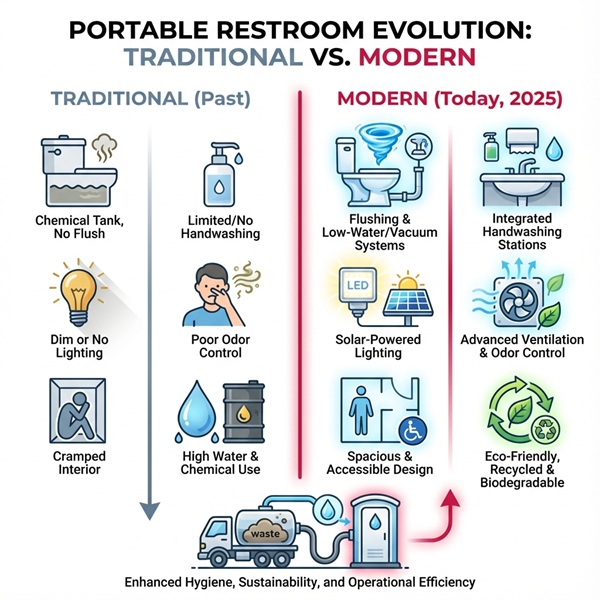
We are now seeing portable units equipped with flushing toilets that mimic the experience of indoor plumbing, a far cry from traditional chemical toilets. Integrated handwashing stations, complete with soap and paper towel dispensers or hand sanitizer, are becoming standard, significantly improving hygiene. Solar-powered lighting systems illuminate interiors, making units safer and more accessible during evening hours or in dimly lit environments. Advanced odor control technology, often incorporating ventilation systems that create continuous airflow and specialized chemical treatments using bio-enzymes to break down odor-causing bacteria, works tirelessly to neutralize unpleasant smells, ensuring a fresher experience for every user. Furthermore, designs now prioritize spacious interiors, offering more room for movement and accommodating diverse user needs, including those requiring accessibility. These improvements are not mere luxuries; they are fundamental to promoting public health, ensuring user satisfaction, and elevating the public perception of events and projects, making portable sanitation a more acceptable and reliable solution in any setting.
Meeting Sustainability & Environmental Goals
The environmental footprint of any industry is under increasing scrutiny, and portable sanitation is no exception. We recognize our responsibility to minimize environmental impact, and this commitment drives significant innovation in sustainable practices and eco-friendly design. Water conservation is paramount, leading to the development of low-flush or vacuum-flush systems that drastically reduce water consumption compared to traditional toilets. Many units are now constructed using recycled materials, reducing reliance on virgin resources and supporting a circular economy where end-of-life plastics are reground and repurposed into new components.
The chemicals used for waste treatment have also evolved. We prioritize biodegradable chemicals that break down naturally, minimizing harm to ecosystems upon disposal. Solar energy integration is a game-changer, powering lights, ventilation fans, and even some flushing mechanisms, reducing reliance on grid electricity and lowering the carbon footprint of each unit. This is especially vital for off-grid deployments where consistent power is not an option. Overall, the industry is moving towards solutions that not only manage waste effectively but do so with a profound respect for the planet.
Here are some eco-friendly features commonly found in modern portable toilets:
- Low-Water or Waterless Flushing Systems: Utilizing minimal water or alternative methods like foam.
- Recycled Content Materials: Construction from post-consumer or post-industrial plastics.
- Biodegradable Waste Treatment Chemicals: Non-toxic, environmentally safe additives.
- Solar-Powered Accessories: Lighting, fans, and sometimes even flushing mechanisms.
- Efficient Ventilation Systems: Reducing the need for harsh chemical deodorizers.
- Composting Options: Converting waste into usable compost by separating liquids and solids and adding carbon-rich materials like sawdust, which reduces liquid waste volume and creates a valuable soil amendment.
- Closed-Loop Water Recycling (for advanced units): Treating and reusing water on-site.
 Improving Operational Efficiency For Rental Companies
For rental companies, the bottom line is often tied to efficiency, durability, and ease of maintenance. Innovations in portable sanitation equipment directly address these operational challenges, allowing us to provide better service more reliably and cost-effectively.
The use of durable materials, such as high-density polyethylene (HDPE), ensures that units can withstand harsh weather conditions, heavy usage, and the rigors of transportation, extending their lifespan and reducing replacement costs. This material is specifically chosen for its chemical resistance to waste and cleaning agents, as well as its flexibility to prevent cracking in extreme temperatures. Designs that prioritize reduced maintenance, with easily accessible components and smooth, non-porous surfaces, make cleaning and servicing quicker and more thorough. Modular designs facilitate easier assembly, disassembly, and repair, allowing for quick customization or replacement of parts. This is particularly vital in emergency scenarios where rapid deployment and repair are critical.
Transport logistics are also significantly improved. Lighter, more stackable units mean more can be transported per trip, reducing fuel consumption and operational costs. This efficiency extends to storage, as compact designs reduce the required yard space. Furthermore, the integration of IoT (Internet of Things) technology offers unprecedented benefits. This includes real-time tracking of units, monitoring of waste levels, and predictive maintenance alerts, all contributing to optimized service routes and proactive problem-solving. For instance, a sensor might detect abnormal motor vibration in a flushing unit, triggering a maintenance alert before the component fails, thus preventing downtime and an emergency service call. These efficiencies enable rental companies to deploy and manage a larger fleet with greater precision, ensuring that critical sanitation needs are met, whether for a planned event or an unforeseen disaster.
Key Technological Advancements Shaping The Industry
The portable sanitation industry is experiencing a renaissance, driven by technological advancements and innovative design philosophies. These developments are not just incremental improvements; they are fundamentally redefining what portable restrooms can offer, changing them into sophisticated, essential components of modern site management and emergency response.
Smart Toilets & IoT Integration
The advent of the Internet of Things (IoT) has brought a new level of intelligence to portable sanitation. Smart toilets, integrated with IoT sensors, provide invaluable data that revolutionizes how units are managed and serviced.
Real-time tank level monitoring allows us to know precisely when a unit needs servicing, preventing overflows and ensuring continuous availability. Supply tracking ensures that essentials like hand sanitizer, toilet paper, and soap are always replenished before they run out. Automated service alerts are sent directly to service technicians, enabling rapid response to issues and optimizing service schedules. This data-driven approach allows for highly efficient route optimization, minimizing travel time and fuel consumption for our emergency vacuum trucks and service vehicles. By analyzing usage patterns through data analytics, we can strategically deploy units to high-traffic areas, anticipate peak demands, and even predict maintenance needs before they become critical. This historical data is invaluable for event planners, allowing them to refine their sanitation plan for future years based on proven usage hotspots. This proactive management significantly improves the user experience and ensures that sanitation facilities are always operational, even in the most demanding emergency situations.
Water-Saving & Eco-Friendly Portable Sanitation Innovation
Our commitment to environmental stewardship is reflected in a range of water-saving and eco-friendly innovations that are setting new industry standards. Vacuum flush technology is a prime example, using air pressure to pull waste into the holding tank with as little as 0.5 liters of water, creating a powerful flush that significantly reduces overall water consumption and odors. Waterless urinals, often featuring an oil-based sealant to block odors, eliminate water usage entirely, contributing to substantial savings, particularly at large events or long-term worksites. Foam-based sanitizing systems offer an effective and water-free alternative for hand hygiene, providing a thorough clean without the need for rinsing.
Beyond individual unit features, some advanced systems are exploring closed-loop water recycling, where wastewater is treated on-site through a multi-stage process involving filtration, biological treatment, and UV sterilization. This treated water is then safely reused for flushing, further reducing environmental impact and reliance on external water sources. This dedication to sustainability is a core part of Satellite’s portable sanitation innovation, pushing boundaries to create solutions that are both effective and environmentally responsible. Composting toilets represent another frontier, converting human waste into nutrient-rich compost, drastically reducing the volume of waste requiring off-site removal by emergency vacuum trucks and offering a sustainable alternative for remote or off-grid locations.
Durability & Design: A Key Portable Sanitation Innovation
The demands placed on portable sanitation units, especially in emergency or disaster relief scenarios, necessitate exceptional durability and thoughtful design. High-density polyethylene (HDPE) has become the material of choice due to its incredible strength-to-weight ratio, resistance to impact, and ease of cleaning. This material ensures that units can withstand the rigors of frequent relocation, heavy usage, and exposure to diverse environmental conditions. The smooth, non-porous interior surfaces are a critical design choice, as they prevent the harboring of bacteria and make the sanitization process faster, more effective, and more hygienic for service crews.
Vandal-resistant features are increasingly integrated into designs, protecting units from damage and ensuring their longevity. These can include heavy-duty door springs, recessed hinges to prevent tampering, and robust locking mechanisms. Crucially, weather resilience is engineered into every aspect, from UV-resistant plastics that prevent fading and cracking to robust construction that can endure high winds, heavy rain, and extreme temperatures. This makes them ideal for disaster recovery deployment, where reliability under adverse conditions is non-negotiable. Beyond functionality, modern aesthetics and customizable exteriors allow units to blend seamlessly into various environments, from upscale events to corporate worksites, enhancing the overall visual appeal. This combination of rugged durability and thoughtful design ensures that portable sanitation units are not just functional, but also reliable, safe, and visually appropriate for any setting.